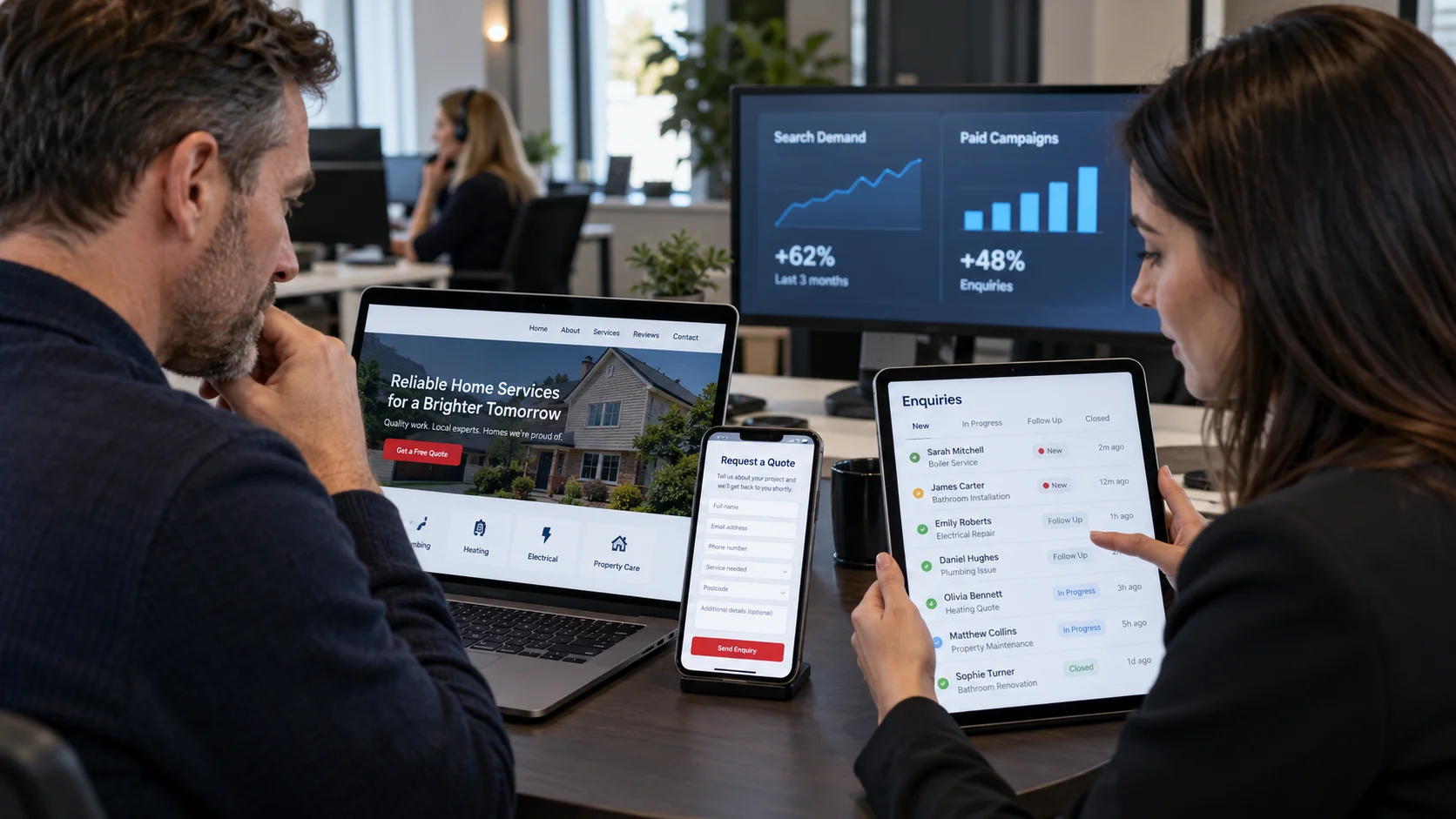
How UK Service Businesses Can Improve Online Lead Generation
A useful starting point is to understand the main digital factors that influence lead generation for UK service businesses: clear service pages, relevant search visibility, paid demand capture, trust signals, strong forms, local relevance and fast follow-up. This guide focuses on the UK buying and implementation questions raised by the search for digital marketing services uk, including scope, ownership, measurement, risks and the point at which related website or technical work matters.
Quick answer: Approach UK service business leads as a sequence: define the outcome, gather inputs, fix foundations, implement the highest-value work, test it and review the data. This prevents teams from scaling a channel or technical build before the basics are reliable.
Start with the decision behind UK service business leads
A useful starting point is to understand the main digital factors that influence lead generation for UK service businesses: clear service pages, relevant search visibility, paid demand capture, trust signals, strong forms, local relevance and fast follow-up.
For QASTCO’s target audience, the useful emphasis is to connect marketing and website performance. It can help businesses identify where leads are being lost before they invest more money in traffic.
What good practice looks like
For the specific question How UK Service Businesses Can Improve Online Lead Generation , the evidence base matters. Current Google and ICO guidance reinforces two procurement realities. Search outcomes cannot be guaranteed by an agency, and marketing measurement or audience activity that uses personal data or tracking technologies needs appropriate UK privacy handling. A supplier should be able to explain both performance assumptions and data responsibilities clearly. For a buyer or implementation team, the useful next step is to convert that guidance into explicit requirements, tests and ownership.
Website readiness
For UK service business leads , traffic acquisition is inefficient when the website is slow, unclear or difficult to convert on. Identify critical site work before scaling spend. If the provider cannot explain this in plain language, the scope is probably not clear enough yet.
Data and ownership
For UK service business leads , keep direct access to advertising, analytics, domains, Search Console, CRM and creative assets. Agree who owns accounts and data at the outset. Write this into the brief so it can be checked during delivery rather than discussed only after results disappoint.
Team and process
For UK service business leads , understand who sets strategy, who does the work, how priorities are approved and how quickly technical changes can be delivered. Ask for the evidence or artefact that proves this step is being managed, such as access, a test plan, a mapping document or a decision log.
Reporting
For UK service business leads , useful reporting explains what changed, why it matters, what was learned and what will happen next. Activity totals alone are not a strategy. The practical test is whether a decision-maker can see who owns the task, what good looks like and what happens if the assumption is wrong.
Commercial model
For UK service business leads , compare scope, exclusions, minimum terms, third-party costs and how additional work is approved rather than comparing one headline monthly fee. Treat this as a dependency, not a decorative extra: weak foundations here tend to create rework elsewhere in the project.
Handover
For UK service business leads , a healthy supplier relationship should still allow an orderly exit with access, history, documentation and assets intact. If the provider cannot explain this in plain language, the scope is probably not clear enough yet.
A decision framework for this choice
For UK service business leads, use the framework below during discovery, procurement or an internal review. It is short enough to use in a working meeting, but it forces the team to expose scope, ownership and evidence gaps before budget or development time is committed to this particular brief.
| Decision area | Practical test |
|---|---|
| Objective | State the problem and the decision the work needs to support. |
| Inputs | Gather access, data, content, stakeholder requirements and constraints. |
| Sequence | Resolve foundations before scaling dependent activity. |
| Validation | Define tests or acceptance criteria before implementation is called complete. |
| Review | Measure outcomes, document learning and decide the next iteration. |
A practical step-by-step approach
- Define the outcome. Write one sentence describing what should be different if the work succeeds. Avoid a channel-only goal such as ‘do more digital marketing services uk’; state the customer or business outcome instead.
- Establish the baseline. Record the current data, website condition, account access, process constraints and known pain points. Without a baseline, improvement can be confused with normal variation.
- Separate must-haves from assumptions. Mark requirements that are essential, then list assumptions that need testing. This makes it easier to phase the work without losing the core outcome.
- Assign owners and approvals. Name who owns data access, content, technical implementation, budget and final approval. Regulated or high-trust topics also need the appropriate internal reviewers involved before launch.
- Implement the smallest coherent change. Deliver enough of the solution to create a complete user or data journey. Avoid isolated tactics that cannot be measured or that depend on unfinished foundations.
- Validate and learn. Check real data, user behaviour, lead or sales feedback and technical health. Record what changed and decide what to keep, fix, stop or test next.
Common mistakes and avoidable risks
The main risks around UK service business leads are usually cumulative rather than dramatic: a vague owner, an unreliable metric, an untested assumption or a missing hand-off can quietly distort the project. For How UK Service Businesses Can Improve Online Lead Generation, the following checks deserve explicit attention.
- Choosing by service count instead of fit
- Giving up ownership of accounts or data
- Accepting activity reports without decisions
- Spreading a small budget across too many channels
- Signing before exclusions, notice and handover are clear
Practical example
Take a business generating traffic from SEO, paid search and social while its website converts poorly. Hiring a separate specialist for every channel may increase activity without resolving the shared bottleneck. The better response to “How UK Service Businesses Can Improve Online Lead Generation” is to identify the constraint first, assign ownership and sequence the work. Sometimes that means fixing measurement and landing pages before increasing media spend.
Budget, resources and trade-offs
Budget decisions for UK service business leads should reflect the exact scope behind “How UK Service Businesses Can Improve Online Lead Generation”. Marketing cost is not just the retainer. Include media spend, software, creative, development, content, internal review and the opportunity cost of slow approvals. A useful agency plan shows how those resources fit together and which dependency limits the next stage of growth.
Questions to settle before acting on digital marketing services uk
A useful decision on digital marketing services uk needs more than a supplier shortlist. Write down what must be true at the end of the work, what evidence will show that it is working, and which constraints cannot be ignored. For “How UK Service Businesses Can Improve Online Lead Generation”, that means turning the general brief into explicit choices about scope, ownership, data, implementation and review. The aim is to make the next decision easier to defend internally, not to create a longer list of services.
- Which commercial problem has priority over the next 90 days?
- Which channels need specialist delivery and which can remain in-house?
- Who owns accounts, data and approvals if the supplier changes?
- What does the retainer include, exclude and treat as additional work?
- How will reporting lead to decisions rather than just activity summaries?
If these questions cannot be answered yet, treat that as a discovery issue rather than a reason to guess. Resolve the highest-risk unknown first, then update the scope. That approach is particularly useful for how uk service businesses can improve online lead generation because the commercial result depends on several connected decisions; changing one channel, page or system without the surrounding context can simply move the bottleneck elsewhere.
Where QASTCO can fit
In the context of UK service business leads, QASTCO’s current service architecture combines web development, SEO, PPC, social, content, local SEO, design, automation and integration. A business does not need all of these at once. The useful role of an integrated partner is to diagnose where the constraint sits and coordinate the disciplines that are actually needed, with direct access to accounts and transparent reporting. The final scope should still be written against the source question rather than treating QASTCO’s complete service menu as the requirement.
What to do next
For How UK Service Businesses Can Improve Online Lead Generation , use the framework above to identify the single biggest unknown. Resolve that first—whether it is data quality, website readiness, permissions, technical feasibility or provider scope—then commit the next stage of budget with better evidence.
Ready to Take the Next Step?
If you are using this guide to shortlist support, compare QASTCO’s current digital-marketing services against your own brief, then use a consultation to agree priorities, ownership and measurement before selecting channels.
Frequently Asked Questions
How do I know whether an agency strategy is specific enough?
It should name the target audience, the commercial outcome, the channels or website changes being prioritised, the measurement plan and the dependencies that could block delivery. Generic promises without these details are difficult to manage.
Should one agency manage every digital channel?
Not automatically. Consolidation can improve coordination, but specialist suppliers may be appropriate for some tasks. The decision should follow the complexity of the work, internal capability and the cost of coordinating multiple teams.
What access should my business retain?
Keep direct access to domains, websites, analytics, advertising accounts, search tools, creative assets and relevant data. Supplier access should support delivery without making the business dependent on one provider for its own records.
How should agency performance be reviewed?
Review agreed outcomes alongside diagnostic metrics. Ask what changed, why it changed, what was implemented, what was learned and which decision follows. Reports should support action rather than simply list activity.
Can a digital agency guarantee rankings or revenue?
No. Search visibility, lead volume and revenue depend on factors beyond one supplier’s control. A credible agency can commit to defined work, measurement, communication and evidence-led optimisation, not a guaranteed market outcome.
What should I compare before choosing UK service business leads?
Compare the provider’s diagnosis, relevant capability, account ownership, reporting, implementation resources and the way it will work with your internal team. A long service list is less useful than a clear plan for your actual constraint.