How Manchester Businesses Should Choose a Web Development Partner
This guide helps Manchester businesses evaluate local and regional web development partners based on technical capability, communication, sector experience, support and understanding of business goals. This guide focuses on the UK buying and implementation questions raised by the search for web development manchester, including scope, ownership, measurement, risks and the point at which related website or technical work matters.
Quick answer: Choose Manchester web development partner by matching the provider’s capabilities to a defined business problem, then checking ownership, process, evidence, reporting and handover. A strong fit is specific about responsibilities and trade-offs; it does not rely on guarantees or a long list of channels.
Start with the decision behind Manchester web development partner
This guide helps Manchester businesses evaluate local and regional web development partners based on technical capability, communication, sector experience, support and understanding of business goals.
For QASTCO’s target audience, the useful emphasis is to be practical rather than location-led marketing alone. It can explain when an in-person discovery session is useful and why the right development expertise still matters more than simply choosing the closest supplier.
What good practice looks like
For the specific question How Manchester Businesses Should Choose a Web Development Partner , the evidence base matters. The NCSC’s current guidance for small organisations emphasises practical controls around accounts, devices and backups, while OWASP’s API Security Top 10 highlights risks such as broken authorisation and authentication. These are reminders that security is a delivery responsibility, not a feature that can be added at the end of a build. For a buyer or implementation team, the useful next step is to convert that guidance into explicit requirements, tests and ownership.
Documentation and ownership
For Manchester web development partner , the business should know who owns code, accounts, domains, infrastructure and third-party licences, plus what is handed over. The practical test is whether a decision-maker can see who owns the task, what good looks like and what happens if the assumption is wrong.
Support
For Manchester web development partner , post-launch support should distinguish defects, maintenance, monitoring and new feature development so expectations are clear. Treat this as a dependency, not a decorative extra: weak foundations here tend to create rework elsewhere in the project.
Requirements
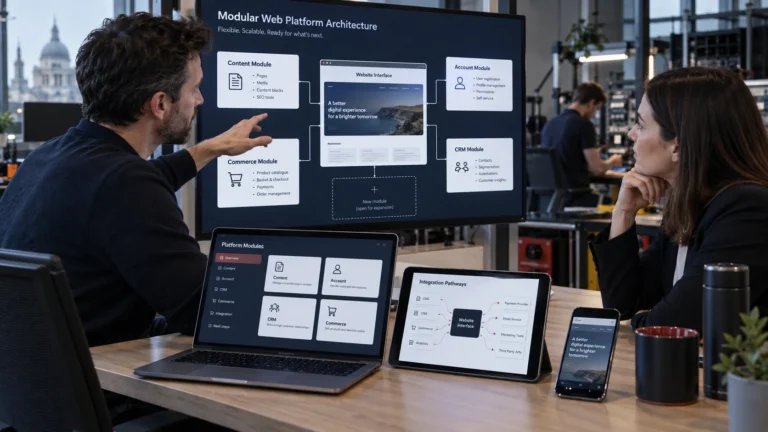
For Manchester web development partner , map users, workflows, data, integrations and acceptance criteria before committing to architecture or a delivery estimate. If the provider cannot explain this in plain language, the scope is probably not clear enough yet.
Architecture
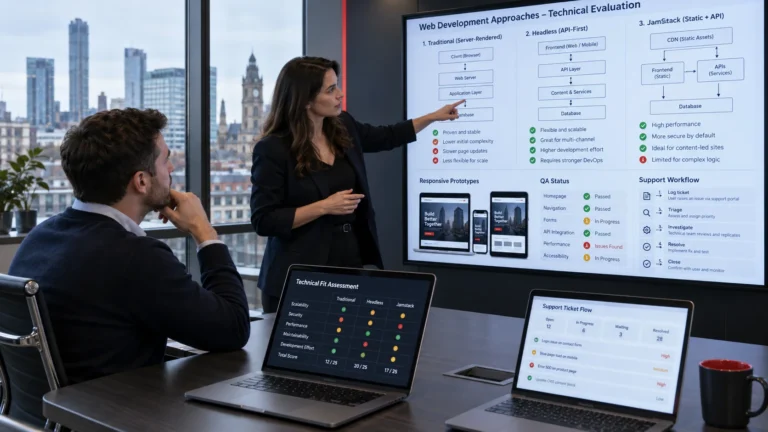
For Manchester web development partner , choose a CMS, framework or custom approach that fits the problem. Bespoke development is valuable when requirements justify it, not because custom is automatically better. Write this into the brief so it can be checked during delivery rather than discussed only after results disappoint.
Data and integrations
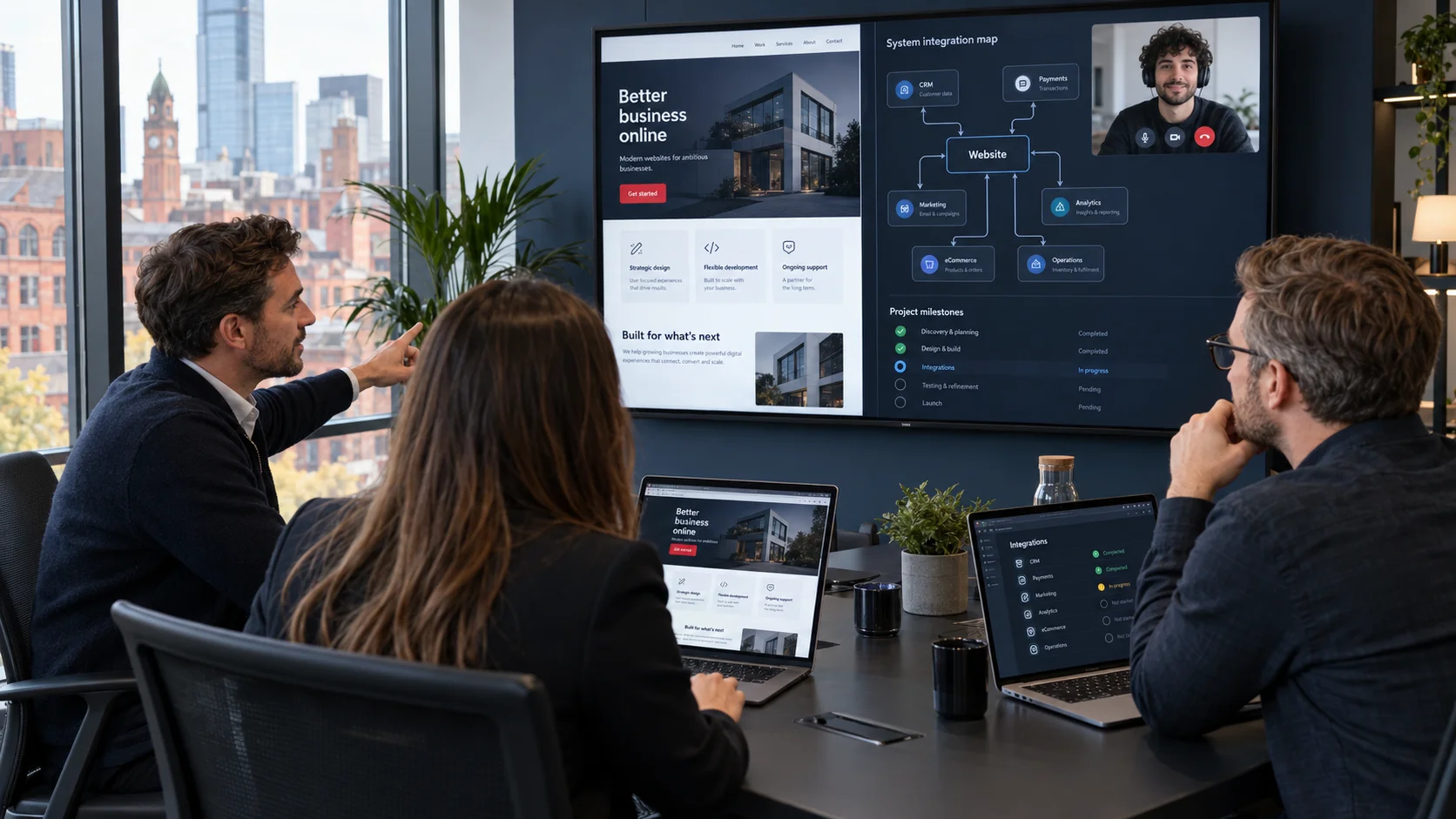
For Manchester web development partner , document which systems exchange data, what the source of truth is and how failures or duplicates will be handled. Ask for the evidence or artefact that proves this step is being managed, such as access, a test plan, a mapping document or a decision log.
Security
For Manchester web development partner , authentication, permissions, secrets, updates and logging need explicit ownership. API projects should consider risks such as broken authorisation and authentication. The practical test is whether a decision-maker can see who owns the task, what good looks like and what happens if the assumption is wrong.
A decision framework for this choice
For Manchester web development partner, use the framework below during discovery, procurement or an internal review. It is short enough to use in a working meeting, but it forces the team to expose scope, ownership and evidence gaps before budget or development time is committed to this particular brief.
| Decision area | Practical test |
|---|---|
| Evidence | Ask what the provider will show before, during and after delivery. |
| Ownership | Confirm who owns accounts, data, code, domains and approvals. |
| Process | Check how discovery, implementation, QA and reporting are run. |
| Fit | Judge relevance to your problem, not the size of the service menu. |
| Exit | Understand handover, access and notice terms before signing. |
A practical step-by-step approach
- Define the outcome. Write one sentence describing what should be different if the work succeeds. Avoid a channel-only goal such as ‘do more web development manchester’; state the customer or business outcome instead.
- Establish the baseline. Record the current data, website condition, account access, process constraints and known pain points. Without a baseline, improvement can be confused with normal variation.
- Separate must-haves from assumptions. Mark requirements that are essential, then list assumptions that need testing. This makes it easier to phase the work without losing the core outcome.
- Assign owners and approvals. Name who owns data access, content, technical implementation, budget and final approval. Regulated or high-trust topics also need the appropriate internal reviewers involved before launch.
- Implement the smallest coherent change. Deliver enough of the solution to create a complete user or data journey. Avoid isolated tactics that cannot be measured or that depend on unfinished foundations.
- Validate and learn. Check real data, user behaviour, lead or sales feedback and technical health. Record what changed and decide what to keep, fix, stop or test next.
Common mistakes and avoidable risks
The main risks around Manchester web development partner are usually cumulative rather than dramatic: a vague owner, an unreliable metric, an untested assumption or a missing hand-off can quietly distort the project. For How Manchester Businesses Should Choose a Web Development Partner, the following checks deserve explicit attention.
- Coding before requirements and acceptance criteria are stable
- Choosing custom development where an established platform would meet the need
- Underestimating data migration and integration edge cases
- Launching without rollback, logging or support ownership
- Leaving code, credentials or infrastructure ownership ambiguous
Practical example
Suppose a business asks for a custom portal because several staff members copy data between a website form, a spreadsheet and a CRM. Before commissioning a bespoke build, map the process. A reliable API connection plus a smaller interface change may solve the problem with less maintenance; alternatively, complex permissions and workflow rules may justify custom software. The requirement, not the technology label, should decide.
Budget, resources and trade-offs
Budget decisions for Manchester web development partner should reflect the exact scope behind “How Manchester Businesses Should Choose a Web Development Partner”. Development cost follows complexity: user roles, data models, integrations, migration, testing, infrastructure and support all matter. Custom work gives flexibility but also creates maintenance responsibilities. Where an established platform covers the requirement well, using it can reduce build and support overhead.
Questions to settle before acting on web development manchester
A useful decision on web development manchester needs more than a supplier shortlist. Write down what must be true at the end of the work, what evidence will show that it is working, and which constraints cannot be ignored. For “How Manchester Businesses Should Choose a Web Development Partner”, that means turning the general brief into explicit choices about scope, ownership, data, implementation and review. The aim is to make the next decision easier to defend internally, not to create a longer list of services.
- Which requirements justify development rather than configuration of an existing platform?
- What data, integrations and user roles create the highest technical risk?
- What are the acceptance criteria for the first useful release?
- Who owns source code, hosting, deployment access and third-party licences?
- How will support, backups, monitoring and future changes be handled?
If these questions cannot be answered yet, treat that as a discovery issue rather than a reason to guess. Resolve the highest-risk unknown first, then update the scope. That approach is particularly useful for how manchester businesses should choose a web development partner because the commercial result depends on several connected decisions; changing one channel, page or system without the surrounding context can simply move the bottleneck elsewhere.
Where QASTCO can fit
In the context of Manchester web development partner, QASTCO currently offers web development, custom software and API/integration work. That makes it relevant where a project moves beyond page design into workflows, data or bespoke functionality. The implementation route should still follow discovery: a standard platform can be the sensible choice when it meets the requirement, while custom development is justified by specific constraints or capabilities. The final scope should still be written against the source question rather than treating QASTCO’s complete service menu as the requirement.
What to do next
For How Manchester Businesses Should Choose a Web Development Partner , use the framework above to identify the single biggest unknown. Resolve that first—whether it is data quality, website readiness, permissions, technical feasibility or provider scope—then commit the next stage of budget with better evidence.
Ready to Take the Next Step?
If the requirement needs development rather than a simple page update, discuss the project with QASTCO and use discovery to confirm architecture, integrations, ownership and the smallest useful first release.
Frequently Asked Questions
Who should own the code and technical accounts?
Ownership should be stated in the contract. The business should understand source-code rights, hosting and domain access, third-party licences, deployment credentials and what is required if the supplier changes.
What should post-launch support include?
Define monitoring, backups, security updates, bug handling, support hours, response expectations and how new feature work is approved. The right model depends on how business-critical the system is.
How do you reduce scope risk on a development project?
Prioritise requirements, validate difficult assumptions early, use prototypes or technical spikes where useful, agree change control and keep acceptance criteria visible. Phased delivery can reduce risk without losing sight of the whole architecture.
What should technical discovery produce for Manchester web development partner?
Discovery should turn business goals into buildable requirements: user roles, workflows, data, integrations, architecture choices, risks, acceptance criteria and a realistic first release. It should reduce uncertainty before large development commitments.
When is custom development justified?
Custom work makes sense when established products cannot meet important workflow, integration, ownership or scalability requirements without creating worse compromises. It is not automatically better than a well-supported standard platform.
How should development quality be tested?
Use functional, integration, responsive, performance and security checks appropriate to the system, plus user acceptance against agreed criteria. Important failure paths should be tested as deliberately as the happy path.